Your Gift. Our Mission. Their Future.
DONATE TODAY. Invest in the PTG programs that are transforming mental health for our nation's heroes.
Make a Gift
Before the call ever comes in, you already know what it might be.
That’s what nearly three decades as a paramedic does to a person. You stop reacting to emergencies and start anticipating them. You learn to think in contingencies, to run through outcomes before they happen, to quietly map out what could go wrong and how you would respond when it does.
For Darrell Demers, that way of thinking didn’t stay on the job. It followed him home. It settled into ordinary moments, into quiet rooms, into the middle of the night when there was no call, no siren, no reason at all for his body to feel like something terrible was about to happen. It became a constant undercurrent, something he carried without ever quite putting words to it.
For most of his adult life, that feeling had a purpose.
Darrell was nineteen years old when he became a paramedic in Massachusetts, one of the youngest in the state at the time. It was 1988, and there weren’t many paramedics then. The system he worked in was high-intensity, designed to respond when something had already gone very wrong.
“We only saw the worst of the worst,” he said.
He spent 28 years in that environment, walking into scenes where people were hurt, dying, or already gone, making decisions that had to be made quickly and without hesitation. There wasn’t space to process what he was seeing in the moment, and there wasn’t much space for it afterward either.
“You had a bad night, you got out at seven in the morning, you went to the bar,” he said. “You didn’t talk about it. You didn’t talk to your family about it.”
So Darrell didn’t either.
Not with his wife, Sharon. Not with anyone.
Sharon had been part of his life from the beginning of his adulthood. They met through a mutual friend and built a life over more than thirty years, raising three children, navigating long hours and real responsibilities, and doing what needed to be done for their family.
For five of those years, Darrell worked two full-time jobs so Sharon could stay home with their kids. He showed up in the way he knew how, consistently and without complaint.
“She’s the best thing that’s ever happened to me,” he said. “I’d be dead or in jail right now if I hadn’t found Sharon.”
The job, though, had its own way of shaping how he moved through the world. It didn’t happen all at once. It showed up gradually, first as awareness, then as vigilance, and eventually as something that remained present even when there was no reason for it to be.
“You see so many bad things happen to good people,” he said, “you start worrying it’s going to happen to you or somebody you love.”
That way of thinking didn’t stay on the job. It followed him into everyday life, showing up in moments that didn’t call for it. Darrell was constantly running through scenarios, planning for outcomes that hadn’t happened, and trying to stay one step ahead of things he couldn’t control.
At night, it didn’t let up.
The dreams were vivid and physical, the kind that don’t fade when you wake up.
“Even in my dreams, I could feel the slipperiness of blood on my fingers,” he said.
He would wake up drenched, changing clothes multiple times a night, unable to settle back into sleep. The images carried into the day, layering onto everything else he was already holding.
He went to doctors. Had blood work, scans, and tests. They couldn’t find anything. And without a clear answer, the question remained. What was happening to him?
By then, Darrell had already made a decision that quietly shifted the direction of his life. He stopped drinking. There was no program, no intervention, just a morning where he woke up and decided that was enough.
“I woke up one day and said, ‘I’m done,’” he recalled. “And I never drank again.”
Without it, there was nothing left to push things down, and what had been sitting beneath the surface became harder to ignore.
In December of 2024, his body made that clear. His sleep was disrupted, his energy was off, and there was a growing sense that something wasn’t right, even if he couldn’t fully explain it.
Around that same time, his son called.
Out of the blue, without knowing anything about what had been going on, he asked a simple question: had Darrell ever heard of Boulder Crest?
There was no obvious reason for the call to come when it did, but it did, and that was enough. Darrell filled out the application that afternoon, and within days, he was connected to a program that would fundamentally change how he understood everything he had been carrying.
Boulder Crest’s Struggle Well training gave him something he had never been taught in nearly three decades of service. It offered a way to understand struggle, to process it, and to move forward without carrying it alone.
But when he first arrived in Texas, he really didn’t know what to expect.
The first few hours felt familiar in their own way. A group of men, each carrying their own experiences, quietly observing one another, trying to understand who was in the room.
“That’s what we do,” he said.
He went in open-minded, even with the instincts that had been shaped over years still in place. As the conversations began and the stories unfolded, something shifted. Listening to the other men, he began to recognize pieces of himself in what they were saying.
“Man, I’m not as nuts as I thought I was,” he said to himself.
That realization opened the door.
One of the program guides said something that stayed with him: “Shame cannot survive being spoken.”
Darrell felt it immediately.
“It felt like a weight was lifted off of me,” he said. “Like, alright, you finally got the guts to say it.”
That moment was part of a larger shift that took place throughout the week, shaped by the people in the room and the space the program created for honesty without judgment.
The connections didn’t end when the week did. The men he met there are still part of his life. He talks to them regularly. He thinks about them often.
And when he returned home, the change was clear. Sharon noticed it right away.
So did his children. His brothers. The people closest to him saw it in the way he moved through his days, in the way he responded, and in the absence of the constant edge that had been there for so long.
“Just my whole demeanor,” he said. “It changed.”
That shift extended beyond what others could see. His body responded in ways his doctor couldn’t fully explain. His blood pressure improved. His cholesterol dropped. The markers that had raised concern returned to normal.
“It’s the only thing I can attribute it to,” he said. “Going to Boulder Crest changed my life.”
These days, his routine reflects a different kind of awareness. He starts his mornings by listening to Bible readings before getting out of bed and ends his days reading The Daily Stoic, paying attention to the patterns that shape how he thinks and responds.
“I use that analogy of the good wolf and the bad wolf,” he said. “It works for me.”
The idea is simple — the version of you that grows stronger is the one you pay attention to. The one you feed. For years, Darrell’s focus had been shaped by worst-case scenarios, by everything that could go wrong. Now, he’s more aware of where his attention goes and what it builds.
The perspective he carries now has shifted over time. He still understands how quickly things can change, but he no longer feels the same need to anticipate every outcome or control what comes next.
“If something terrible happens, I can’t change it,” he said. “All I can do is meet it as it comes.”
What remains steady is what has always mattered most — his family, his wife, and the life they built together.
“I love her more today than the day I married her,” he said.
When he went to Texas, Sharon placed a note in his bag without telling him. He found it when he arrived, a quiet reminder that he wasn’t walking into something unknown alone. Later, she wrote another note to one of the guides, thanking him for what he had done for her husband.
That’s who she is.
And Darrell knows exactly what that has meant in his life.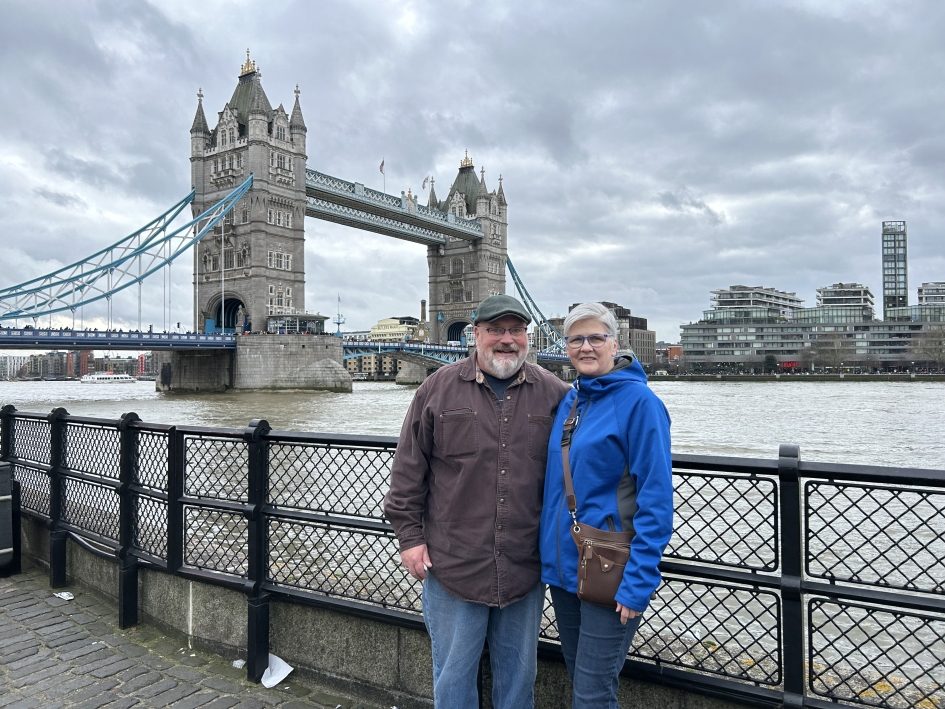 There are still difficult memories and moments that carry weight. They remain part of his story, but they no longer define how he moves through his life.
Today, when Darrell shares his experience, it comes from an understanding of what it means to carry things alone for too long and what becomes possible when you don’t have to anymore.
“It’s okay to feel bad. It’s okay to cry,” he said. “You don’t have to have a stiff upper lip all the time.”
That understanding shapes how he lives now. When uncertainty shows up or old patterns try to resurface, he returns to what he learned — the awareness that he doesn’t have to live in constant anticipation, that he can be present in the life in front of him.
The job taught him how quickly things can go wrong. That hasn’t changed.
But now, he’s learning how much can go right.
For Darrell, Struggle Well became more than a training he attended. It became a way of understanding his experiences and a way of moving forward. Listen to more of his story in his episode of the Struggle Well Podcast. To learn more about Boulder Crest Foundation and the programs that support our nation’s veterans, service members, and first responders, visit bouldercrest.org.
Your support powers life-changing programs offered at no charge to veterans, military, first responders, and their families. With your help, our Warriors won't just survive — they'll thrive.

We have received your email sign-up. Please tell us more about yourself.